Liquid Gold

It looks like my newsletter yesterday on what actually goes into the cost of a gallon of gas sparked a much-needed conversation. If you haven’t read it yet, start there before diving in here.
Once people saw that the true cost to extract, refine, and distribute a gallon of gas is roughly $1.50 to $2.00, the blinders started to come off. So how in the world do we end up paying over $6.00 a gallon in blue states like California—and more importantly, how do we fix it?
One area that clearly caused confusion was the idea that the United States produces massive amounts of oil but still “needs” to import it because our refineries can’t process domestic crude. It’s a common claim—and it’s mostly wrong.
In fact, I received several emails from readers about this after yesterday’s newsletter. So I did a little research to help clarify what’s really going on.
Let’s walk through the facts.
The U.S. is one of the world’s largest oil producers, pumping roughly 13 million barrels per day—much of it light, sweet crude from shale formations like the Permian Basin. At the same time, we continue to import heavier, sour crude from countries like Canada and Saudi Arabia. On the surface, that looks absurd. Why import oil if we already have so much of it?
Here’s the key point: this isn’t about what U.S. refineries can do. It’s about what makes the most economic sense.
American refineries are among the most advanced in the world. They can process light shale crude, and they do it every single day. The idea that they’re somehow “unable” to refine domestic oil is a myth—one that confuses technical capability with economic optimization.
For decades, refiners invested billions upgrading facilities to handle heavier, more complex crude because that’s where the market was heading. Those investments paid off: they could buy discounted heavy oil and turn it into high-value fuels like gasoline and diesel. Gulf Coast refineries in particular became refining powerhouses.
Then the shale revolution flipped the script. Suddenly America wasn’t short on light crude — we were drowning in it.
Refineries had spent billions building equipment to process heavy, thick crude oil.
When you run mostly light, sweet crude instead, that expensive equipment sits idle. Light crude also produces a lot more gasoline and lighter fuels than the refinery is designed to handle, which can create backups and inefficiencies. The refinery still works, but it doesn’t run as well or make as much money.
So refiners do what any smart business would do: they blend some domestic light crude with imported heavier crude. This lets them keep the whole facility running at peak efficiency. The extra light U.S. crude that isn’t needed here gets exported to Europe and Asia, where their refineries are better set up for it.
That’s not dysfunction. That’s a global market working the way it’s supposed to — matching the right type of oil with the right type of refinery.
That global integration, however, creates another problem and is why threats from Iran in the Strait of Hormuz drive up prices at the pump here at home, even when America produces plenty of its own oil.
Roughly 20 million barrels per day—about one-fifth of global oil consumption and a quarter of seaborne traded oil—pass through the Strait of Hormuz. Much of it comes from major producers in the Persian Gulf and heads primarily to Asia. The U.S. imports relatively little directly from that region these days (we’re a net exporter overall). So why do our prices spike when Iran threatens to close or disrupt the strait?
Because oil is a globally traded commodity. Benchmark prices like Brent crude set the tone for the entire world market, including what U.S. refiners pay for inputs and what they can earn on exports. A credible threat to Hormuz creates a massive risk premium: shippers demand higher insurance, tankers reroute or slow down, buyers scramble for alternative supplies, and speculators price in potential shortages. That lifts global prices almost immediately.
U.S. light crude gets exported into that same market. When global prices rise, domestic crude prices rise in tandem to stay competitive. Refiners face higher replacement costs overall—even for the barrels they source domestically. Those costs flow through to wholesale gasoline, then to the pump.
It’s not that we’re short on American oil; it’s that the world price floor moves up, and we’re plugged into the global system.
This is the flip side of the efficiency I described earlier. The same market forces that let us export surplus light crude and optimize refining also mean we don’t get to fully insulate ourselves when our enemies hold us hostage.
So, the system that America built may optimize prices globally—but for everyday Americans, especially in certain states, it’s a very different story. While the market works efficiently at a global level, bad policy decisions at the state level have pushed gas prices in some places completely out of control.
Take California…
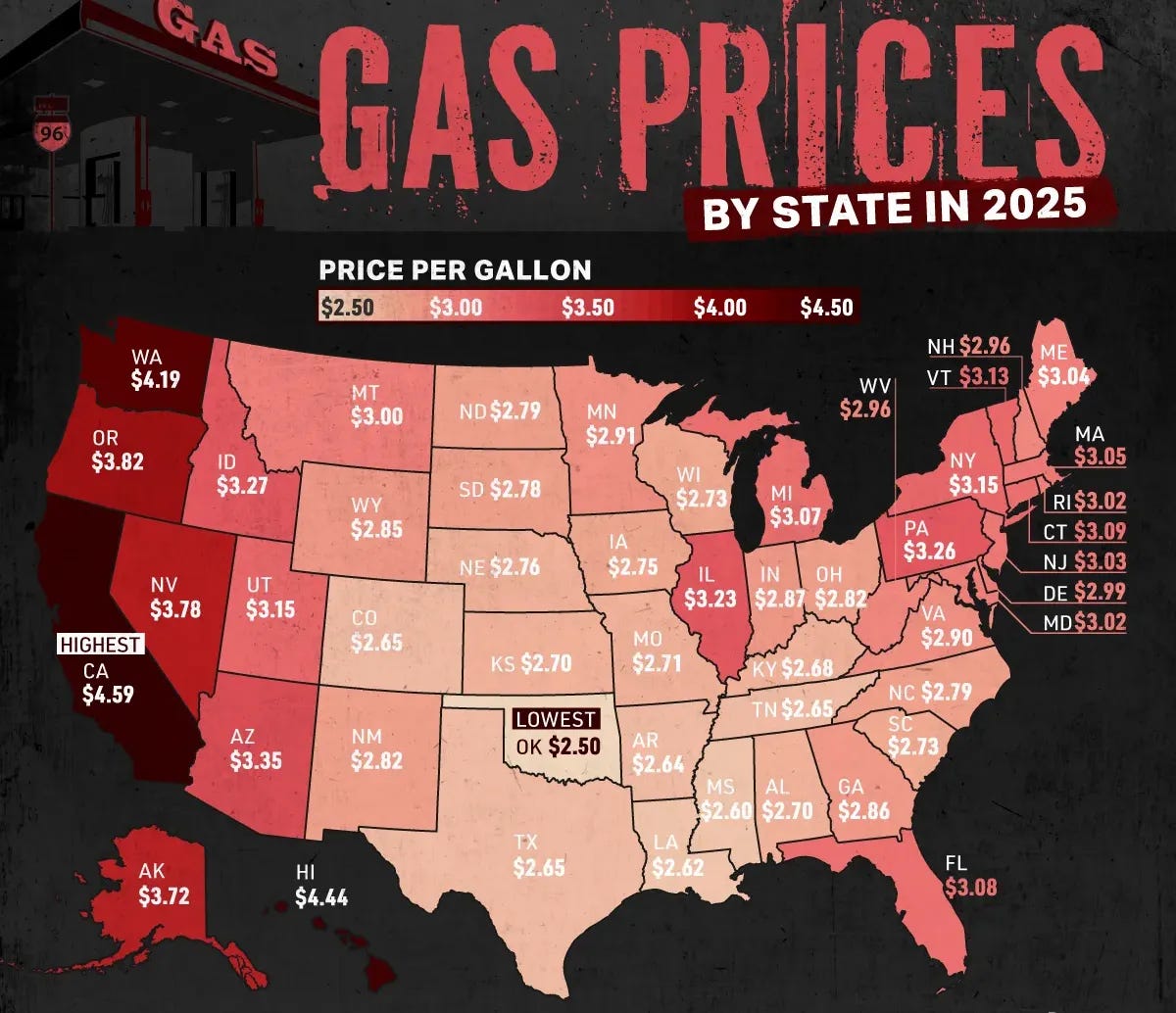
A gallon of regular gas is now running around $6.15. Break that down: about $1.40 of that is taxes and fees, largely going to the state. Another major driver is crude and refining costs—roughly $4 per gallon—because California imports about 75% of its crude, much of it foreign and heavier. That’s nearly double the typical $1.50–$2.00 it costs to extract, refine, and distribute American light sweet crude into a gallon of gas.
Even before the Iran war began, California was still paying close to $5 a gallon of gas - the highest in the nation.
That didn’t happen by accident. It’s the result of decades of policy decisions that created a high tax system and a structural bottleneck.
Start with supply. California has effectively walled itself off from the rest of the U.S. energy system. There are no major pipelines bringing crude from Texas or the Midwest, which means the state can’t easily access abundant, lower-cost domestic oil. Instead, it relies heavily on imports—much of it from overseas.
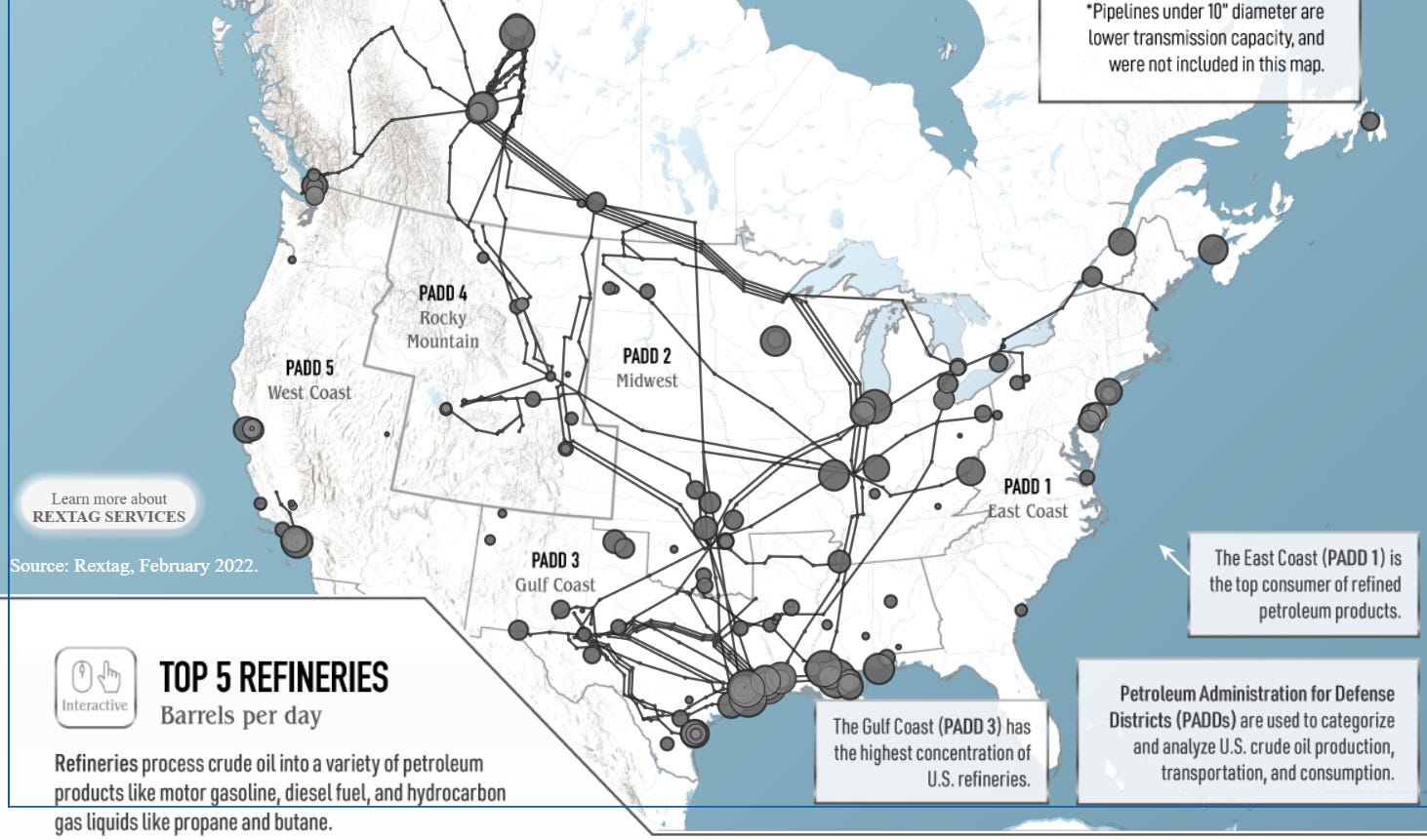
Now layer in refining. California requires a specialized gasoline blend to meet its environmental standards. The problem is that only a limited number of refineries can produce it. So when supply tightens, you can’t bring in fuel from other states to stabilize prices.
When a refinery goes down—planned or unplanned—prices spike quickly because there’s no cushion.
Then come the added costs. Taxes, environmental fees, compliance costs, permitting delays, and regulatory overhead all stack on top. The result is one of the most expensive and least flexible fuel markets in the country.
This wasn’t inevitable. It was built—policy by policy, restriction by restriction—over time. And it’s fixable. But not overnight.
The solution starts with removing the artificial constraints that limit supply and flexibility.
First, infrastructure. California—and states like it—need better access to domestic energy through expanded pipeline networks. Even partial connectivity to existing systems would reduce reliance on foreign imports and lower input costs.
Second, protect and expand refining capacity. That means streamlining permits for upgrades, preventing premature shutdowns, and encouraging investment in modern, cleaner facilities.
Third, build flexibility into the system. Temporary waivers or broader fuel compatibility during supply disruptions would prevent price spikes every time a refinery goes offline.
And in the near term, expand domestic transport options—even rail—because moving American crude within our own country should never be harder than importing it from overseas.
Finally, take a hard look at the tax and fee structure that quietly adds almost two dollars per gallon before consumers even start pumping.
Because here’s the truth: California isn’t expensive because oil is scarce.
It’s expensive because access is restricted, infrastructure is limited, and policy decisions have boxed the system into a corner.
Meanwhile, the rest of the country is producing energy at scale, exporting surplus, and operating within a global system that—when allowed to function—actually keeps prices stable.
We don’t have a supply problem. We don’t have a capability problem. We have a man-made bottleneck problem.
And until that bottleneck is broken—with pipelines, refining capacity, and policies that prioritize access over restriction—Americans in states like California will keep paying inflated prices for energy that already exists right here at home.
We also need to plan for unexpected disruptions that can cripple domestic supply and send prices surging in specific regions.
During hurricane season, for example, as much as 90 percent of crude oil production in the Gulf of Mexico can be forced offline. And not all of it comes back quickly. As Andrew Gross of AAA has noted, some damaged rigs don’t return to operation for months—or at all.
Refining capacity takes a hit too. Hurricanes like Ida and Nicholas didn’t just flood facilities—they knocked out power across the Gulf Coast. No electricity means no refining. Even when storms pass, restarting operations can take time, leaving supply constrained.
We’ve seen similar issues outside hurricane zones. Refinery outages in places like Indiana have recently driven Midwest gas prices up by as much as 80 cents in a matter of days. When a key facility goes offline and there’s no backup capacity, prices respond immediately.
And even after oil is refined, geography still matters.
The closer you are to refining capacity, the less you tend to pay. In Texas—where refineries are concentrated, especially around Houston—gas prices are significantly lower. Compare that to states like Nevada or those on the West Coast, where there are only a handful of refineries, and prices are consistently higher.
This is exactly why infrastructure and redundancy matter.
We should continue balancing abundant American light crude with strategic imports of heavier oil where it keeps refineries efficient and supply stable. But we also have to fix the self-inflicted bottlenecks—especially in high-cost states. That means building more pipelines to move domestic crude efficiently to where it’s needed. It means protecting and expanding refining capacity with streamlined permitting instead of driving it away.
It also means building resilience into the system—so when a hurricane hits, a refinery goes down, or a regional disruption occurs, prices don’t spike overnight because there’s no backup plan. Even rail transport of domestic oil, in some cases, is more practical than the regulatory maze blocking better infrastructure today.
If we want stable, affordable energy, we don’t just need supply—we need a system that can deliver it reliably, even when things go wrong.
My research has shown me that America doesn’t have an energy supply problem. We don’t have a refining capability problem. We have a self-inflicted distribution and policy problem. We need to get out of our own way and Make America Great Again smartly utilizing the liquid gold right under our feet.
If you enjoy my articles, please consider making a donation. This is what one of my readers had to say about my work. Thank you!

My work is free for all but supported by donations from many generous readers like Sparky. Thank you to all who have donated in the past. I truly appreciate you!
How can you donate? In many ways: You can fund me by becoming a paid subscriber on Substack, donate by credit or debit card here or by Cash App at $TierneyRealNews, send me a check to Peggy Tierney, PO Box 242, Spooner, Wisconsin 54801- or just send me a note or a card! I love hearing from you.
If you use the Substack app to read my newsletters - please make sure you check your settings so that you receive it BOTH by email and in the app. I don’t want you to miss a newsletter!
You can always email me at peggy@TierneyRealNewsNetwork.com. Please follow me on Telegram at t.me/TierneyRealNews. Follow me on Facebook at https://www.facebook.com/profile.php?id=100079025148615. Or you can find me on Truth Social @MaggiePeggy123.
Well done, Peggy. This absolutely clears up any confusion that’s been deliberately inserted into the energy supply narratives most often spread by the legacy media, and unfortunately slso by much of the alternative media. Thank you.
FYI, most of the US gulf state refineries were set up to refine Venezuelan heavy crude oil before Chavez. Now thanks to smart Trump foreign policy, Venezuela will quickly ramp production and exports to the US , reducing the need for any Middle East crude.