Standing!

If you’d like to view this article on my website, click here.
The Supreme Court just handed down a landmark decision for election integrity. In a 7–2 decision on January 14, 2026, the Court ruled in Bost v. Illinois State Board of Elections that candidates for office automatically have standing to challenge the way votes are counted in their own elections. That’s a huge win for election integrity and a game-changer headed into the midterms.
Remember how in 2020, President Trump and others kept getting their challenges thrown out because courts said they didn’t have “standing”? That’s now history. The Court just made it clear that candidates always have a personal stake in fair election rules—because they’re the ones directly competing under those rules.

Chief Justice Roberts even said it plainly: “A candidate has a personal stake in the rules that govern the counting of votes in his election.”
This case came out of Illinois, where state law lets mail-in ballots postmarked by Election Day be counted up to 14 days later. Under Bost, candidates can now challenge those kinds of laws before an election if they think the rules threaten the fairness or integrity of the process. They don’t have to wait until after votes are counted and then race against impossible deadlines to prove fraud or errors.
The decision completely changes the game. For years, courts brushed off these cases, saying election rules applied to everyone and no one was uniquely harmed. Now the Supreme Court says candidates are uniquely affected—because shady or sloppy processes can dilute legitimate votes, force campaigns to spend more on monitoring, or even damage reputations if people lose faith in the results.
This lines up directly with what went wrong in 2020. Lawsuits like Texas v. Pennsylvania, Trump v. Boockvar, Wood v. Raffensperger, King v. Whitmer, and others all got tossed for lack of standing. That loophole is now closed.
Expect a wave of pre-election suits from MAGA challenging rules like extended ballot deadlines, unattended drop boxes, loose signature verification, and ballot curing. Republican candidates and the RNC are already signaling they’ll use this decision to push back early, instead of fighting uphill battles after Election Day.
Another case to watch is Watson v. Republican National Committee out of Mississippi. It challenges a state law that counts mail ballots received up to five business days after Election Day. If the Supreme Court sides against that grace period, it could shake up election rules in over a dozen states, tightening deadlines and possibly restoring more consistent national standards.
The bottom line: By lowering the bar, the decision makes it far harder for lower courts to dismiss challenges early on procedural grounds. Bost puts power back in the hands of candidates and voters who want fair and transparent elections. It ensures that questionable election rules can be challenged before the damage is done. For anyone who’s been fighting for election integrity these past few years, this is a breakthrough moment.
Here are some of the major cases in 2020 where the courts refused to hear the cases because of lack of standing.
Texas v. Pennsylvania (U.S. Supreme Court, December 2020): Texas sued Georgia, Michigan, Pennsylvania, and Wisconsin, alleging improper election administration diluted its votes. The Court unanimously denied leave to file, ruling Texas lacked standing because it had “not demonstrated a judicially cognizable interest in the manner in which another State conducts its elections.” This high-profile case sought to invalidate results in four battleground states.
Donald J. Trump for President, Inc. v. Boockvar (M.D. Pa., November 2020; affirmed by 3rd Circuit): The Trump campaign challenged Pennsylvania’s notice-and-cure policies for mail ballots and poll-watcher access, claiming equal protection violations. The district court (Judge Brann) found the campaign lacked standing due to no concrete injury in fact, calling claims “strained legal arguments without merit and speculative accusations, unsupported by evidence.” The 3rd Circuit upheld, noting no disparate treatment of Trump votes specifically.
Bowyer v. Ducey (D. Ariz., December 2020): Plaintiffs (including Republican electors) alleged widespread fraud in Arizona. The court dismissed largely for lack of standing, though it also addressed merits, finding claims based on “anonymous witnesses, hearsay, and irrelevant analysis” rather than evidence.
King v. Whitmer (E.D. Mich., December 2020): Republican electors challenged Michigan’s results on fraud and procedural grounds. The court noted lack of standing as a basis for dismissal (though it reached merits), rejecting claims as speculative with no evidence of altered ballots.
Wood v. Raffensperger (N.D. Ga., November 2020; affirmed by 11th Circuit): Voter Lin Wood challenged Georgia’s absentee and recount procedures. The district court indicated lack of standing (or laches) but ruled on merits; the 11th Circuit affirmed, emphasizing no particularized injury from alleged vote dilution.
Feehan v. Wisconsin Elections Commission (E.D. Wis., December 2020): A presidential elector sought to decertify Wisconsin results, alleging violations of election laws. The court dismissed for lack of Article III standing, noting claims were generalized and relief sought was beyond redress (e.g., no “time machine” to fix issues).
Think about that. All those cases were never heard because the courts said that the candidates had no ‘standing’ to contest the rules of their own elections and if they wanted to they need to present evidence of fraud within 10 days!
Most people don’t understand that the Constitution does not specify any remedy for election fraud. It’s very vague. Most people don’t understand that candidates can lose an election by just a few votes (weeks after the election is over because ballots are still being counted) and that candidate has NO recourse to contest it. Those days are over. This Supreme Court ruling changes the whole ball game.
If you enjoy my articles, please consider making a donation. This is what one of my readers had to say about my work. Thank you!
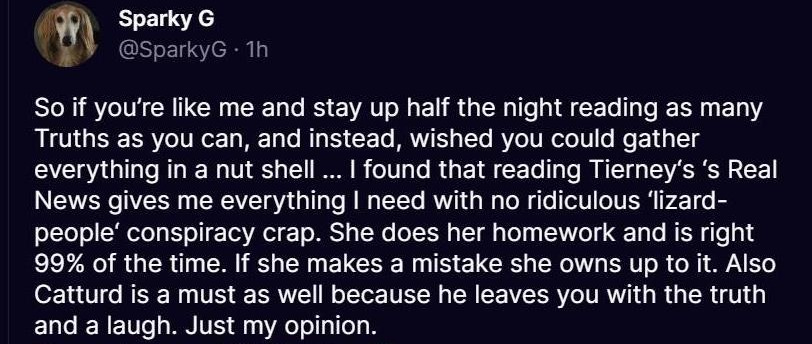
My work is free for all but supported by donations from many generous readers like Sparky. Thank you to all who have donated in the past. I truly appreciate you!
How can you donate? In many ways: You can fund me by becoming a paid subscriber on Substack, donate by credit or debit card here or by Cash App at $TierneyRealNews, send me a check to Peggy Tierney, PO Box 242, Spooner, Wisconsin 54801- or just send me a note or a card! I love hearing from you.
If you use the Substack app to read my newsletters - please make sure you check your settings so that you receive it BOTH by email and in the app. I don’t want you to miss a newsletter!
You can always email me at peggy@TierneyRealNewsNetwork.com. Please follow me on Telegram at t.me/TierneyRealNews. Follow me on Facebook at https://www.facebook.com/profile.php?id=100079025148615. Or you can find me on Truth Social at https://truthsocial.com/@maggiepeggy123.